
MyDataWork’s use-case suggestions help you organize familiar work, uncover overlooked assets and connect them to the decisions and outcomes they could support.
Importing files is a useful beginning. Making them useful together is the next step. An analyst may work across spreadsheets, SQL scripts, dashboards and workflows, yet still need to establish which assets support a particular question, who depends on the answer and what the work is intended to achieve.
MyDataWork’s use-case discovery helps bridge that gap. It reviews imported asset metadata to suggest new use cases and additional assets for use cases you already have. You examine the supporting evidence, refine the proposal and decide what to accept. Available in the direct subscription, commercial AWS Marketplace and AWS GovCloud editions, it provides a practical starting point for organizing the work behind your assets.
Start with a question you already need to answer
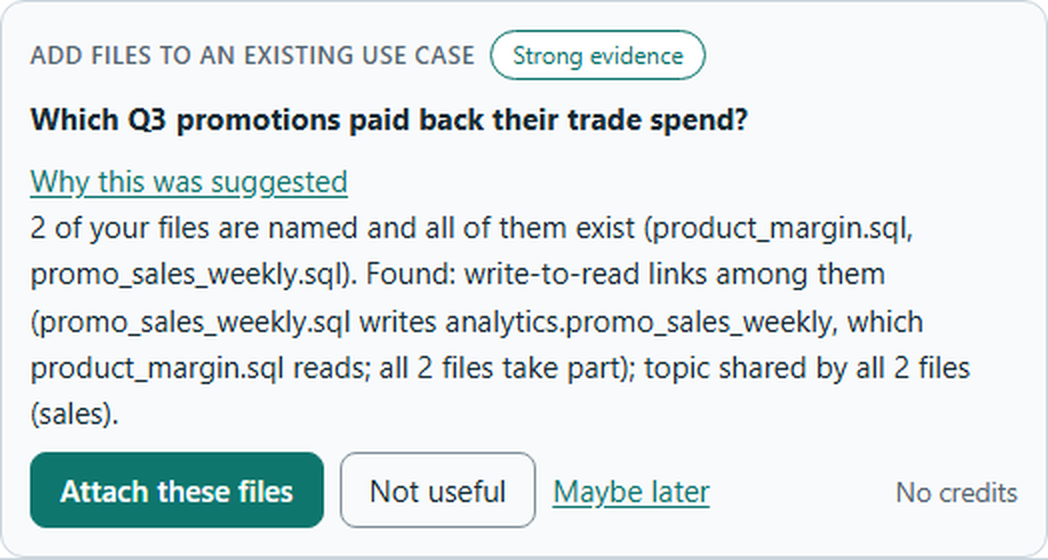
In our consumer-goods demonstration, analyst Lena wants to understand which Q3 promotions paid back their trade spend. She brings together files from her laptop through the Windows Connector and models from her team’s GitHub repository. The business question is familiar; assembling the relevant work around it takes more effort.
MyDataWork suggests files to attach to that existing use case and explains the metadata supporting the suggestion. Lena can review the proposal before accepting the links. For a proposed new use case, she can edit its title and description before creating it.
This gives her something specific to evaluate instead of another blank form. From there, she can develop the use case with objectives, stakeholders and recorded outcomes, keeping the purpose of the work connected to the assets that support it.
Find something useful you weren’t looking for
The more valuable suggestion may involve an asset the analyst had not considered.
In Lena’s demonstration, an overlooked product-margin model brings cost-related context into the promotion question. Sales lift alone does not answer whether a promotion paid back its trade spend. Finding that model gives Lena a reason to investigate whether it could strengthen her analysis.
MyDataWork does not calculate the promotion’s profitability in this workflow. It helps surface an asset worth examining and shows why it was suggested. Lena decides whether the model is appropriate, whether its assumptions fit the question and what additional evidence she needs.
That possibility changes the purpose of discovery. It can help organize work you already intend to capture, while also bringing useful parts of your analytical estate into view.
Understand the difference between a dependency and a useful connection
Assets can contribute to the same decision without having a direct technical dependency. A capacity workbook and a service dashboard, for example, might belong to one planning discussion even when neither directly feeds the other.
Technical lineage describes relationships supported by extracted references or documented connections. A use case records why people bring assets together to support a question or outcome. Linking an asset to a use case does not create a technical lineage relationship.
MyDataWork’s suggestions expose supporting metadata and evidence labels for review. “No direct dependency detected” does not necessarily mean an asset is irrelevant. Equally, a strong technical connection does not establish that an asset is suitable for a particular business decision. The analyst provides that judgment.
Apply the same approach to agency work
Agency analysts face similar challenges across program reporting, grants, service delivery and oversight. In MyDataWork for AWS GovCloud (US), discovery offers the same review-and-accept approach for organizing analytical assets around agency questions.
A team preparing a service-performance review could investigate suggested assets, adapt a proposed use case to its mission and terminology, and identify the people who rely on the result. The use case becomes a place to develop the context behind the analysis as the work progresses.
Commercial and GovCloud editions use different AI services and have edition-specific credit charges. In each, the analyst remains responsible for reviewing and accepting suggestions.
Turn an import into a workspace for everyday work
You choose when discovery runs. The app shows the analysis scope and credit cost before you begin. Suggestions use cataloged metadata rather than querying the underlying business records, and no proposed use case is created or suggested asset link added until you accept it.
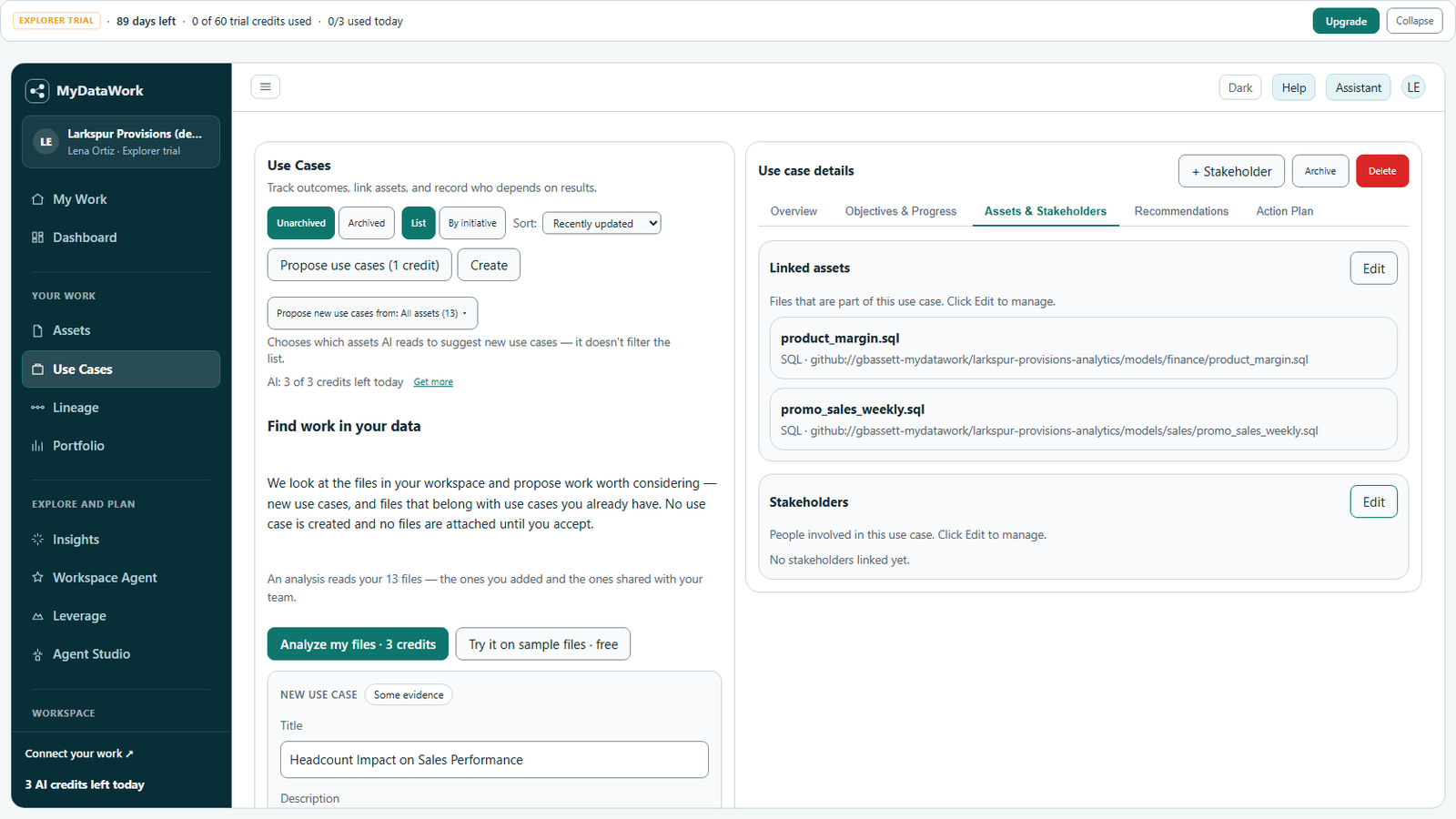
Once accepted, the use case can develop with your work. Add stakeholders, refine the objective, connect further assets and record progress or value as evidence becomes available. As your catalog changes, another analysis can offer further suggestions to review.
The result is a more useful starting point: a workspace organized around questions and responsibilities, with assets connected to the work they support. That makes it easier to return to MyDataWork for the next review, handover or planning conversation.
See what your assets could support
Watch Lena review the evidence, uncover an overlooked model and decide what belongs in her workspace.
